Ecological Approach to BJJ Pedagogy
The focus is on an adaptive, exploratory, and athlete-centered methodology.
Rooted in Ecological Dynamics, this approach emphasizes the dynamic interaction between the individual, task, and environment, fostering skill adaptation rather than rote memorization.
The Goal
To cultivate adaptive problem-solvers who can perceive opportunities and act decisively, rather than athletes who rely on rigid, pre-learned sequences. The ecological approach respects the complexity and chaos of live BJJ, preparing practitioners for the fluid, emergent realities of competition.
Practical Applications in BJJ
- Constraint Manipulation: Limit grips, alter starting positions, or impose time constraints to shape desired learning outcomes.
- Variability in Drills: Regularly change sparring partners, introduce “imperfect” scenarios, or create asymmetric training tasks to foster adaptability.
- Game-Based Learning: Use task-based “mini-games” that replicate match-like situations, promoting decision-making under pressure.
- Less Rote Coaching: Shift from “step-by-step” technical breakdowns to guided discovery, where athletes are encouraged to solve problems through exploration.
flowchart TD
A[Constraints] -->|Manipulate Individual / Task / Environment| B[Affordances]
B -->|Perceived by Athlete| C[Perception-Action Coupling]
C -->|Continuous Interaction Loop| D[Self-Organization]
D -->|Emergent Movement Solutions| E[Skill Adaptation]
E -->|Functional Adaptability| F[Performance in Dynamic Scenarios]

subgraph Constraints Types
	A1[Individual Constraints]
	A2[Task Constraints]
	A3[Environmental Constraints]
end

A1 --> A
A2 --> A
A3 --> A
Key Principles
Constraints-Led Approach (CLA)
Learning emerges by manipulating constraints:
- Individual Constraints: attributes like size, flexibility, experience.
- Task Constraints: rules, objectives, or time limits in a drill.
- Environmental Constraints: space limitations, mat conditions, partner variability.
Coaches shape learning environments rather than dictate movements, allowing athletes to self-organize solutions.
Affordances & Perception-Action Coupling
Athletes learn to perceive affordances—opportunities for action (e.g., an opening to sweep)—and act upon them fluidly. Training must maintain perception-action coupling, ensuring athletes perceive realistic cues as they perform techniques.
Representative Learning Design (RLD)
Practice tasks should mirror the complexity of actual matches. Positional sparring and live scenarios create meaningful learning by preserving the context of competition.
Differential Learning (DL) & Movement Variability
Instead of drilling “perfect reps,” athletes are exposed to movement variability, sometimes even deliberate “errors.” This noise forces them to adapt and discover multiple ways to achieve a task (degeneracy), enhancing resilience in unpredictable situations.
Nonlinear Pedagogy & Self-Organization
Learning is not a straight line. Through exploratory practice, athletes develop personal movement solutions. Coaches act as designers of tasks and environments, allowing skills to emerge organically through self-organization rather than through explicit instruction.
Practice Design in Ecological Approach
BJJ Ecological Practice Design Template
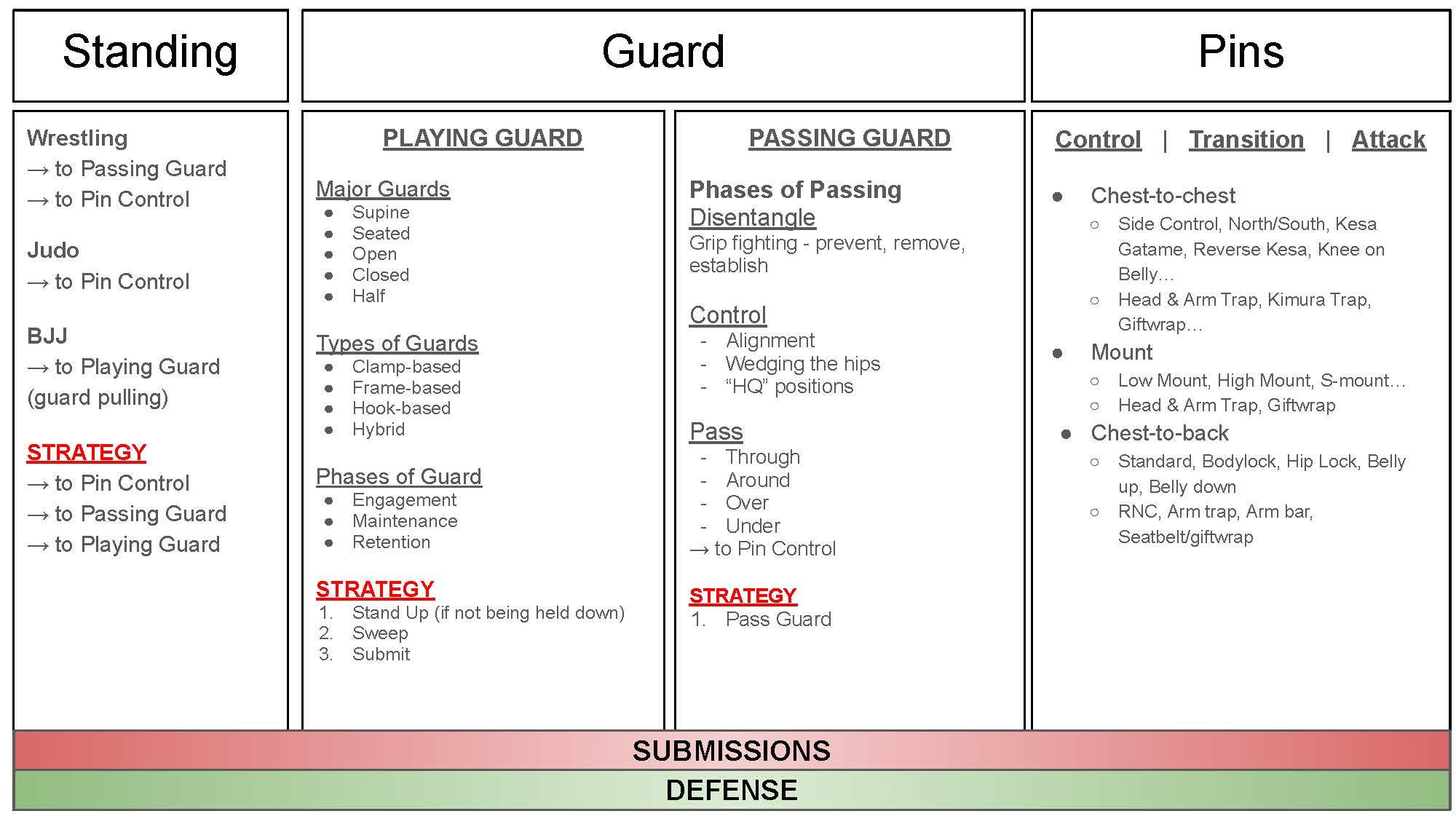
Source: How to Design an Ecological Dynamics Jiu Jitsu Class
Practice Task Types
- Continuous Games simulate prolonged scrambles or flow rolling
- Terminal Games simulate isolated, decisive exchanges
flowchart TD
    A[Task Design] --> B1(Continuous Games
Ongoing Play)
    A --> B2(Terminal Games
Goal-Bound Play)

    B1 --> C[Perception-Action Coupling]
    B2 --> C

    C --> D[Self-Organization]
    D --> E[Skill Adaptation]

    A --> F[Constraint Scaling]
    F -->|Adjust Complexity| A

    click B1 href "#Continuous Games"
    click B2 href "#Terminal Games"
    click C href "#Perception-Action Coupling"
    click D href "#Self-Organization"
click E href "#Skill Adaptation"| Continuous Game Example | Terminal Game Example |
|---|---|
| Guard Recovery Loop | Pass-or-Sweep Drill |
| Flow Rolling with Positional Focus | Submission Shootout |
| Scramble Maintenance Drill | Back Control Escape/Finish |
Scale complexity by adjusting:
- Flow Conditions (Continuous/Terminal)
- Time constraints
- Starting positions
- Grips or mobility limitations
Continuous Games
- Continuous games are designed to maintain ongoing play without a defined end point.
- The focus is on sustained interaction, keeping the athlete engaged in problem-solving loops.
Useful for
- Building endurance of decision-making under fatigue.
- Developing flow and transitions.
- Reinforcing perception-action coupling over time.
Examples of Continuous Games
flowchart TD
    Start[Start Position
Open Guard]
    Perception[Perceive Affordances
Passing lanes, balance shifts]
    Action[Execute Action
Frame, Recover, Transition]
    Feedback[Immediate Feedback
from partner/environment]
    LoopDecision{Guard Maintained?}

    Start --> Perception --> Action --> Feedback --> LoopDecision
    LoopDecision -- Yes --> Perception
    LoopDecision -- No --> Reset[Reset Position
Continue Game]
    Reset --> Perception
Guard Recovery Loop
- Setup: One player starts in bottom guard, the other in top passing.
- Rule: Every time the passer breaks the guard or nearly passes, the bottom player immediately resets guard (no stopping). The goal is continuous guard retention practice.
- Constraint Options:
- Limit top player’s grips.
- Reduce mat space for higher complexity.
- Add time limits to encourage pace.
Flow Rolling with Positional Focus
- Setup: Light, continuous rolling where players are encouraged to flow through positions (no submissions).
- Rule: Emphasis is on transitions and movement fluidity, no “hard stops” or holds.
- Constraint Options:
- Focus only on transitions between specific positions (e.g., guard to mount).
- Mandate continuous movement, no static holds longer than 3 seconds.
Scramble Maintenance Drill
- Setup: Start in a near-pass position (e.g., side control underhook scramble).
- Rule: Players are not allowed to "settle" into a dominant position. If the passer secures side control, they must intentionally let the bottom player escape to maintain the scramble.
- Constraint Options:
- Add “no grips” rules.
- Require continuous movement chains of at least 3 actions.
Terminal Games
- Terminal games are structured with a clear terminal objective or outcome, such as a submission, sweep, or positional control.
- The task resets upon the successful completion of the terminal goal.
Useful for
- Emphasizing goal-directed behavior.
- Teaching clarity of objectives under match conditions.
- Developing the ability to capitalize on decisive opportunities.
Examples of Terminal Games
flowchart TD
    Start[Start Position
e.g., Guard]
    Perception[Perceive Affordances
Passing lanes, sweeps, balance shifts]
    Action[Execute Action
Pass attempt, Sweep attempt]
    Feedback[Immediate Feedback
Success/Failure Cues]
    GoalCheck{Goal Achieved?}

    Start --> Perception --> Action --> Feedback --> GoalCheck
    GoalCheck -- No --> Perception
    GoalCheck -- Yes --> End[Game Ends
Reset Drill / Rotate Partners]
Pass-or-Sweep Drill
- Setup: One player in top guard, other in bottom.
- Rule: The game ends when:
- Top player secures a guard pass.
- Bottom player completes a sweep.
- Reset after each terminal outcome.
- Constraint Options:
- Limit grips for top player.
- Add time constraints (e.g., 30s to pass/sweep).
Submission Shootout
- Setup: Start in a neutral position like closed guard.
- Rule: Game ends when one player achieves a submission.
- Reset after every submission, rotating partners if desired.
- Constraint Options:
- Only allow specific submission types (e.g., chokes only).
- Add a time limit per round.
flowchart TD
    Start[Start Position
e.g., Closed Guard]
    Perception[Perceive Affordances
Submission Openings, Grip Breaks]
    Action[Execute Attack
Submission Attempt or Positional Control]
    Feedback[Immediate Feedback
Opponent’s Defense, Openings]
    GoalCheck{Submission Achieved?}

    Start --> Perception --> Action --> Feedback --> GoalCheck
    GoalCheck -- No --> Perception
    GoalCheck -- Yes --> End[Game Ends
Reset Drill / Rotate Partners]
Back Control Escape/Finish Drill
- Setup: One player starts with back control, seatbelt grip.
- Rule: Game ends when:
- Top player secures a rear-naked choke (terminal outcome).
- Bottom player escapes to a neutral or dominant position.
- Reset after outcome achieved.
- Constraint Options:
- Start with/without hooks in.
- Restrict escape directions (e.g., only turn into guard)
Optional Practice Design Concepts (Advanced):
- Transition Games — Tasks that focus on seamless movement between positions.
- Constraint Scaling Loops — Adjustments made in real-time based on learner performance.
- Task Simplification (within representativeness) — Simplifying tasks without breaking perception-action couplings.
Terminology
Ecological Dynamics
A framework viewing skill acquisition as an emergent, self-organizing process influenced by individual, task, and environmental interactions.
Constraints
- Individual Constraints: athlete’s physical and psychological characteristics.
- Task Constraints: rules, objectives, or structure of the practice task.
- Environmental Constraints: external factors like space, partner behavior, or setting.
Constraints-Led Approach (CLA)
A coaching strategy where constraints are manipulated to guide learning without explicit instructions.
Affordances
Opportunities for action perceived in the environment relative to one’s capabilities (e.g., an opponent's exposed limb).
Perception-Action Coupling
The ongoing interaction loop between perceiving opportunities (affordances) and acting on them.
Representative Learning Design (RLD)
Designing training scenarios that preserve the perceptual and decision-making demands of actual competition.
Differential Learning (DL)
A method introducing variability or noise into practice to promote adaptability and exploration of movement solutions.
Movement Variability
Natural fluctuations in movement that enhance adaptability rather than being seen as errors.
Degeneracy
The ability of different movement patterns to achieve the same outcome.
Nonlinear Pedagogy
Recognizes learning as a non-linear, individualized process emphasizing exploration over repetition.
Progressive Constraint Manipulation
Designing a Scaffolding Pathway through Constraints
The intentional design of practice tasks where constraints are incrementally varied to introduce increasing complexity, facilitating adaptable skill development in a progressive and representative manner.
- Emphasis: A methodical, structured progression of constraint variability to facilitate the natural emergence of adaptable skills.
- Primary Focus: Designing long-term learning progressions by deliberately changing constraints over time to increase representativeness and complexity.
- Application Example in BJJ: Over a month, gradually shifting guard passing drills from static to dynamic, with increasing opponent resistance and environmental perturbations.
Scaling (of Constraints)
Scaling = Matching Complexity to Learner Capacity
- Emphasis: Adjusting the difficulty level of constraints to match the learner’s current capabilities.
- Primary Focus: Ensuring task accessibility and developmentally appropriate challenge.
- Application Example in BJJ: Reducing grip options or enlarging mat space for beginners, then gradually tightening constraints as skill improves.
- Scaling Up Complexity → Advanced students face more chaotic or restrictive scenarios.
- Scaling Down Complexity → Simplifying tasks for novices.
Self-Organization
The emergence of functional movement patterns through the interaction of constraints, without direct instruction.
Skill Adaptation
The process of refining flexible, adaptable skills for varied and dynamic environments, rather than memorizing fixed techniques.